Workflows
Use workflows to tackle complex use cases using a structured flow of agentic and non-agentic steps.
IBM Bob Premium Package for i includes several workflows for tackling complex IBM i use cases. Each workflow is designed to execute a set of steps that are either agentic or non-agentic in nature. While agentic steps — executed via subagents or subtasks — allow Bob to fully leverage its reasoning and tool-use capabilities to handle open-ended, multi-step work, non-agentic steps perform deterministic operations that reduce token consumption and produce more consistent and predictable results.
RPG Modernization
Convert OPM and fixed-format ILE RPG source to modern free-format RPG.
Business Rules Extraction
Analyze RPG source code (OPM and ILE) and extract business rules into a Markdown report with Mermaid diagrams.
RPGUnit Test Plan Creation
Analyze IBM i code and generate structured RPGUnit test plan documents.
RPGUnit Test Suite Implementation
Implement RPGUnit test suites from existing test plan documents.
SQL Index Strategy Advisor
Analyze Db2 for i SQL performance data and establish an optimized index strategy.
Starting a workflow
There are two ways in which a workflow can be started.
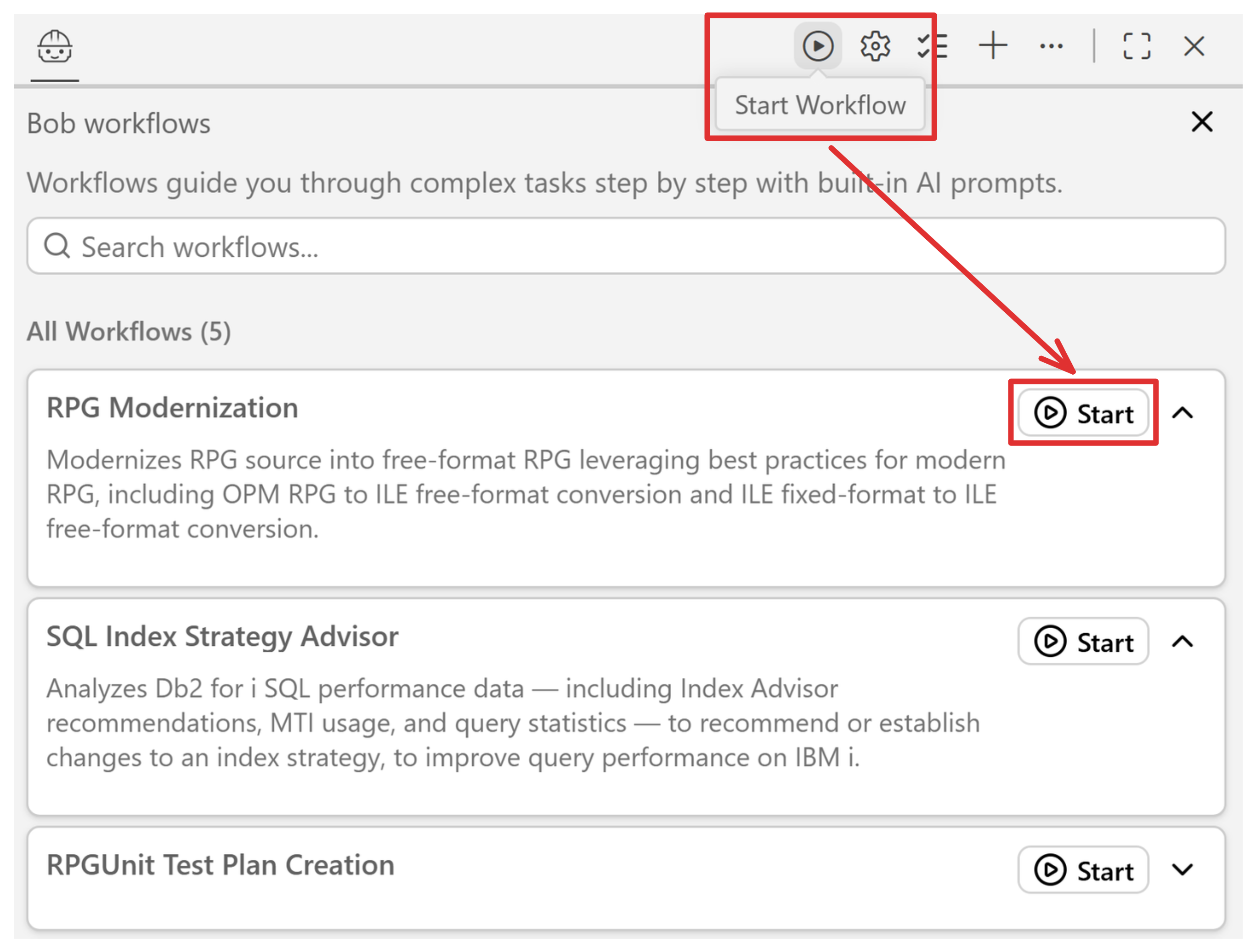
A workflow can be started directly by selecting the Start Workflow button at the top of the chat, selecting the desired workspace, and clicking Start on the workflow you would like to run.
A workflow can be automatically suggested in the chat by Bob in the case it deems your request is best suited to be tackled via one of the available workflows. You can click Start workflow to proceed with running it.

Most IBM i workflows are only visible and available to Bob when connected to an IBM i.
RPG Modernization workflow
Modernizes RPG source code into free-format ILE RPG following best practices, covering both OPM-to-ILE conversion and ILE fixed-format to ILE free-format conversion.
This workflow is available when working in a local or library list workspace.
Capabilities
- Converts OPM RPG (RPG II, RPG III, RPG/400) source to ILE free-format RPG
- Converts ILE fixed-format RPG to ILE free-format RPG
- Automatically detects the RPG variant and routes to the appropriate conversion path
- Performs a 2 phased conversion based on the source
- Phase 1: Externalizes I-specs (input file descriptions) and O-specs (output specifications)
- Phase 2: Converts all remaining fixed-format H, F, D, and C specifications to free-format
- Runs optional pre-conversion compilation to validate the source before proceeding to subsequent steps
- Generates a summary report at the end of the workflow
Business Rules Extraction workflow
Analyzes RPG source code (OPM RPG II, RPG III, RPG/400, RPGLE, and SQLRPGLE) and extracts business rules, decision logic, validations, and process knowledge into a structured, business-friendly Markdown report with Mermaid diagrams.
This workflow is available when working in a local, home directory, or library list workspace.
Capabilities
- Parses the source to identify external dependencies (database files, programs, service programs, copy members, SQL references, IBM i system APIs)
- Skips sources with no meaningful RPG constructs (plain text, header-only files) and surfaces a warning instead of producing misleading output
- Detects RPG cycle-driven programs and activates the appropriate RPG skills before extraction
- Splits the source into logical sections (procedures, subroutines, mainline) and runs parallel subagents to perform the extraction
- Reads external dependencies (physical files, logical files, copybooks) to enrich the extracted rules with full field-level context
- Synthesizes extracted rules into an 8-section executive Markdown report covering validations, calculations, decision logic, data integrity, and process flow
- Generates up to 3 Mermaid diagrams (process flow, decision logic, state transitions) and injects them into the corresponding report sections
- Saves the report to a local path or an IFS path
RPGUnit Test Plan Creation workflow
Creates an RPGUnit test plan for IBM i code by analyzing how the code is used and generating structured markdown documents that define modules and their exported APIs, outline test suites and cases, and establish shared test utilities which are all to be used later during test implementation (via the RPGUnit Test Suite Implementation workflow).
This workflow is available when working in a local or library list workspace.
Capabilities
- Creates four types of structured Markdown test plan documents:
- Template documents: Reusable markdown templates that define the structure for module, test suite, and utilities documents. These are set up once and used as the blueprint for every document created in this test plan.
- Module documents: One document per module describing each API (exported procedure). This includes its purpose, parameters, return values, side effects, and a flow chart tracing all execution branches.
- Test suite documents: One document per module listing the planned test suites and test cases. This includes what each test validates, its setup, inputs, assertions, and implementation status. This is the primary artifact used when implementing tests and its existence depends on there being an associated module document.
- Test utilities document: A single document cataloguing shared helper procedures (e.g. mock table setup) that are referenced across multiple test suites.
- Runs existing test suites to understand current test state before planning
- Leverages subtask to generate or update the test plan documents
RPGUnit Test Suite Implementation workflow
Implements the RPGUnit test suites based on existing test plan documents by generating test code, executing the test suites, and resolving any errors that arise. These test plan documents must be first generated via the previous RPGUnit Test Plan Creation workflow.
This workflow is available when working in a local or library list workspace.
Capabilities
- Reads structured test plan documents to understand the application, the state of existing tests and the tests that are to be written.
- Writes or updates the test suites according to the test plan
- Creates or updates the RPGUnit test configuration file (
testing.json) as needed - Runs the generated test suites and iterates until all newly generated tests pass
- Acknowledges any pre-existing test failures and asks whether to fix them as part of the task
- Provides a final summary of each test suite file created and the number of test cases implemented
SQL Index Strategy Advisor workflow
Analyzes Db2 for i SQL performance data — including Index Advisor recommendations, MTI usage, and query statistics — to recommend or establish changes to an index strategy, to improve query performance on IBM i.
This workflow is available when working in a library list workspace.
Capabilities
- Choose between capturing new performance data or using existing plan cache snapshots or database monitor data
- Analyzes performance data and generates AI-driven index recommendations
- Presents recommended indexes for user review and selective approval before creation
- Creates selected indexes directly on the IBM i upon approval
- Generates a final summary report covering the data source, analysis findings, indexes created, and recommended next steps