
IBM Bob Premium Package for Z (Bob PP4Z) brings specialized IBM Z expertise directly into Bob. PP4Z is a premium capability built on top of Bob's agentic foundation, designed to support mainframe teams across a broader range of development work.
PP4Z is designed for the realities of enterprise mainframe development: large applications, tightly connected systems, cryptic variables, long-lived business logic, and modernization work that must be done safely, consistently, and with deep architectural awareness.
This post explains why large mainframe estates push general-purpose AI coding tools to their limits. It covers what structured metadata and data dictionaries provide beyond raw source retrieval, how model augmentation grounds responses in IBM-approved documentation, and how PP4Z combines Bob's model-driven reasoning with deterministic IBM Z analysis and validation tools.
A premium experience for IBM Z development
Modern IBM Z development covers a wide range of activities beyond writing new code, like understanding existing applications, tracing how a change ripples through a large system, documenting decades-old business logic, and making modernization decisions that need to be both safe and defensible.
PP4Z is designed to support that breadth. It is built on Bob's agentic foundation and leverages Bob's skills, subagents, and workflows. It then extends them with what IBM Z development specifically requires: structured knowledge of large, interconnected application landscapes, deterministic analysis tools for COBOL, PL/I, and Assembler, and Z-specific modes tuned to how mainframe teams work.
Local and enterprise metadata for deeper application insight
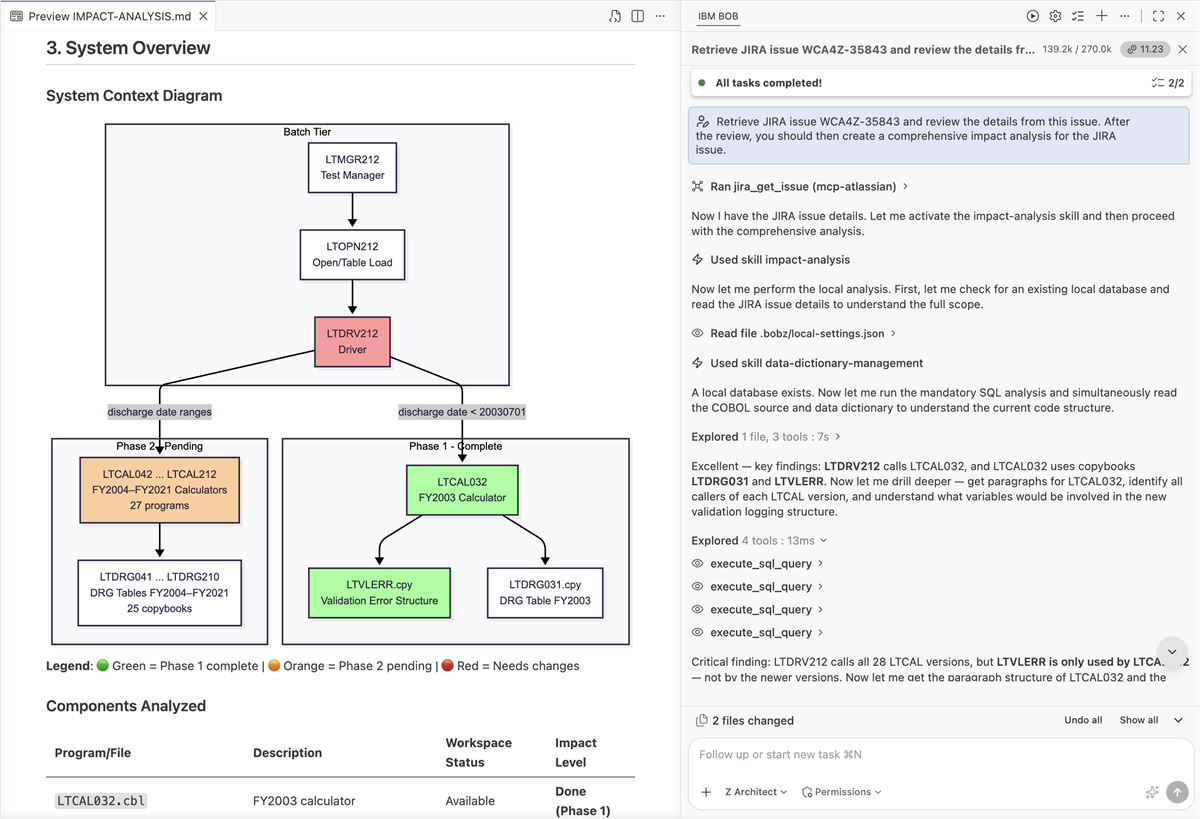
A large mainframe application can consist of tens of thousands of interconnected programs spanning COBOL, PL/I, and Assembler, coordinated by batch schedulers, and integrated with subsystems like Db2, CICS, and IMS. The model cannot reason across that estate through context alone. Before it can answer a question, it has to determine which programs and relationships matter.
This is where raw source retrieval breaks down. Consider asking a general-purpose AI to find every program that calls a shared date-processing utility (the kind of routine called by dozens of programs across a large COBOL estate). Static text search finds explicit call statements but misses dynamic calls, where the program name is stored in a variable and resolved at runtime. Run the same query twice and the model may choose a different search strategy each time, returning different results. The answer looks plausible, but it is not reliable.
PP4Z addresses this by building a structured, queryable representation of the application before AI reasoning begins. Local scanners populate metadata directly from the workspace. They are the same scanners used in the Z Understand container and are available without an upload step. The metadata captures program relationships, call hierarchies, control flow, data flow, SQL usage, transaction definitions, and resource dependencies in a form the model can query precisely.
For enterprise-scale analysis, teams can connect PP4Z to the Z Understand container. This gives Bob access to structured metadata spanning the broader application portfolio, including relationships beyond the developer's local workspace. Developers can then ask Bob questions such as:
- Which programs call a given utility?
- Which programs read a given SQL table?
- What could be affected if this field changes size?
Bob queries the metadata to identify the relevant programs and relationships, then examines the corresponding source where deeper analysis is needed. The response is grounded in consistent, queryable application data rather than a probabilistic search across raw source files.
Model augmentation: closing the IBM Z knowledge gap
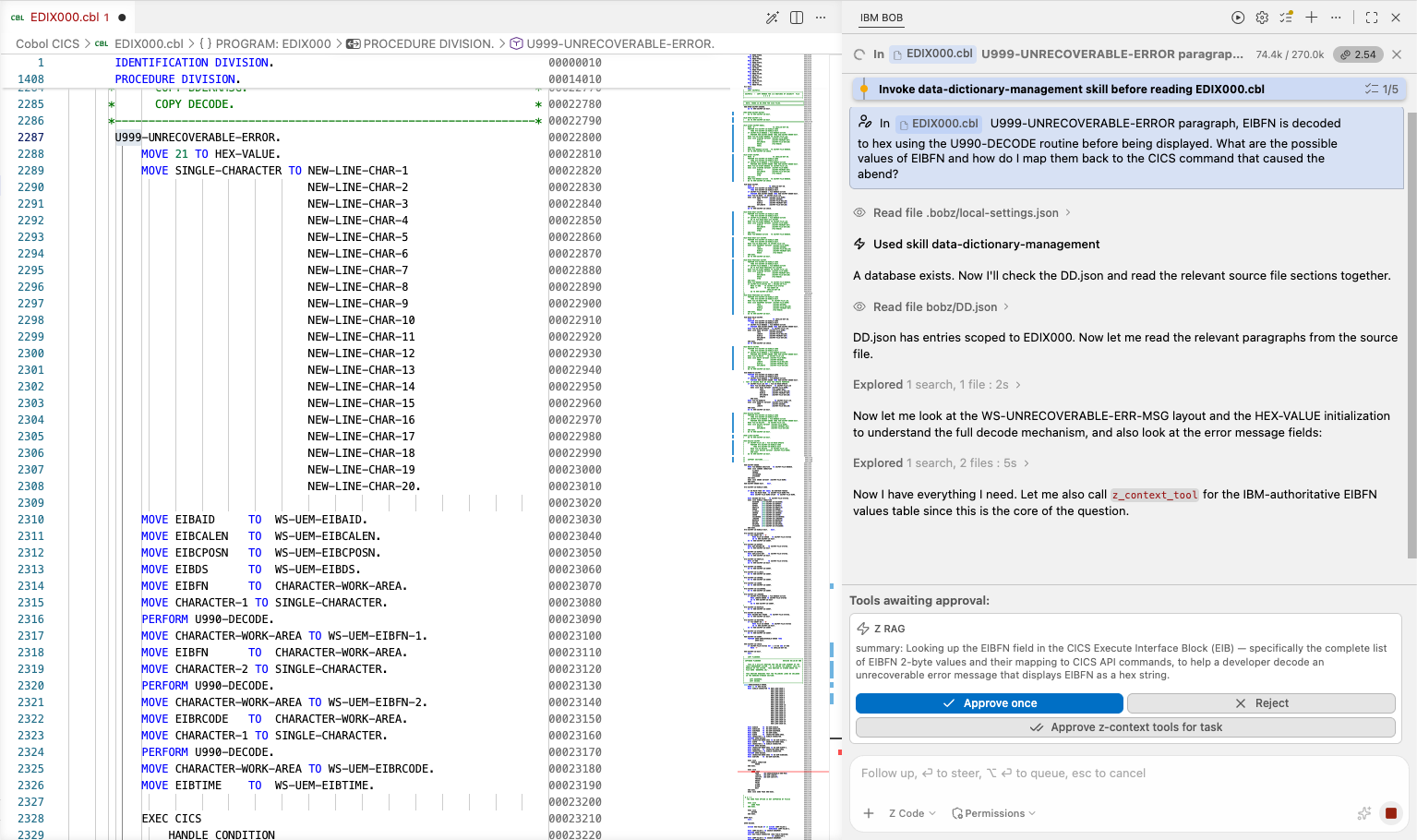
Most IBM Z application code sits in private enterprise repositories. A general-purpose model has no access to the source, conventions, or business context in those systems. It must also work with fewer public examples than it would find for mainstream languages and frameworks.
PP4Z addresses this through model augmentation: curated IBM Z reference material is analyzed, indexed, and made available to Bob so that responses touching IBM Z languages and middleware are grounded in what IBM actually documents. The augmentation layer processes IBM Z documentation in a way that makes it actionable for the specific kinds of questions developers ask: calling conventions, field structures, middleware behaviors, and documented edge cases that a general model with limited exposure to these environments can get wrong in ways that are difficult to spot.
The practical difference shows up when a developer is writing or modifying code that interacts with IBM Z middleware. A general model may produce syntactically plausible code that violates precise IBM-specified contracts. With model augmentation, the knowledge PP4Z draws on when composing a response is grounded in what IBM actually specifies, not a best-effort approximation from limited training exposure.
Business-aware AI with data dictionaries
Unclear variable names exist in every codebase, but IBM Z applications present this problem at a different scale and in a different form. In many long-lived COBOL applications, business logic and application logic are tightly intertwined. Meaning is encoded in terse field names, copybook layouts, and naming conventions that have accumulated over decades without consistent enforcement. Consider this WORKING-STORAGE SECTION:
01 WK10.
   10 WK10-QUDISP             PICTURE  9(10)
                                               VALUE ZERO.
   10 WK10-QUPIL              PICTURE  9(3)
                                               VALUE ZERO.
   10 WK10-QUDIS              PICTURE  9(15)
                                               VALUE ZERO.
   10 WK10-QUMYD              PICTURE  9(10)
                                               VALUE ZERO.
Four numeric accumulators sit in a group called WK10. Nothing in the names or PICTURE clauses tells a developer or a model what any of them represent. A model without additional context might observe that WK10-QUDISP and WK10-QUDIS are both numeric fields, likely distance-related given the QU and DIS fragments, and guess that they serve similar purposes. That guess is wrong. The one-character difference between them is the entire story.
With the PP4Z-generated data dictionary, the distinction is explicit. WK10-QUDIS is the cumulative total distance flown across all pilots. It is incremented throughout flight record processing and used in the final average calculation. WK10-QUDISP is a per-pilot accumulator. It resets to zero at the start of each pilot's processing block and is displayed alongside that pilot's identification. One resets per pilot; the other never resets. An explanation or impact analysis that conflates them produces the wrong answer about what the program does.
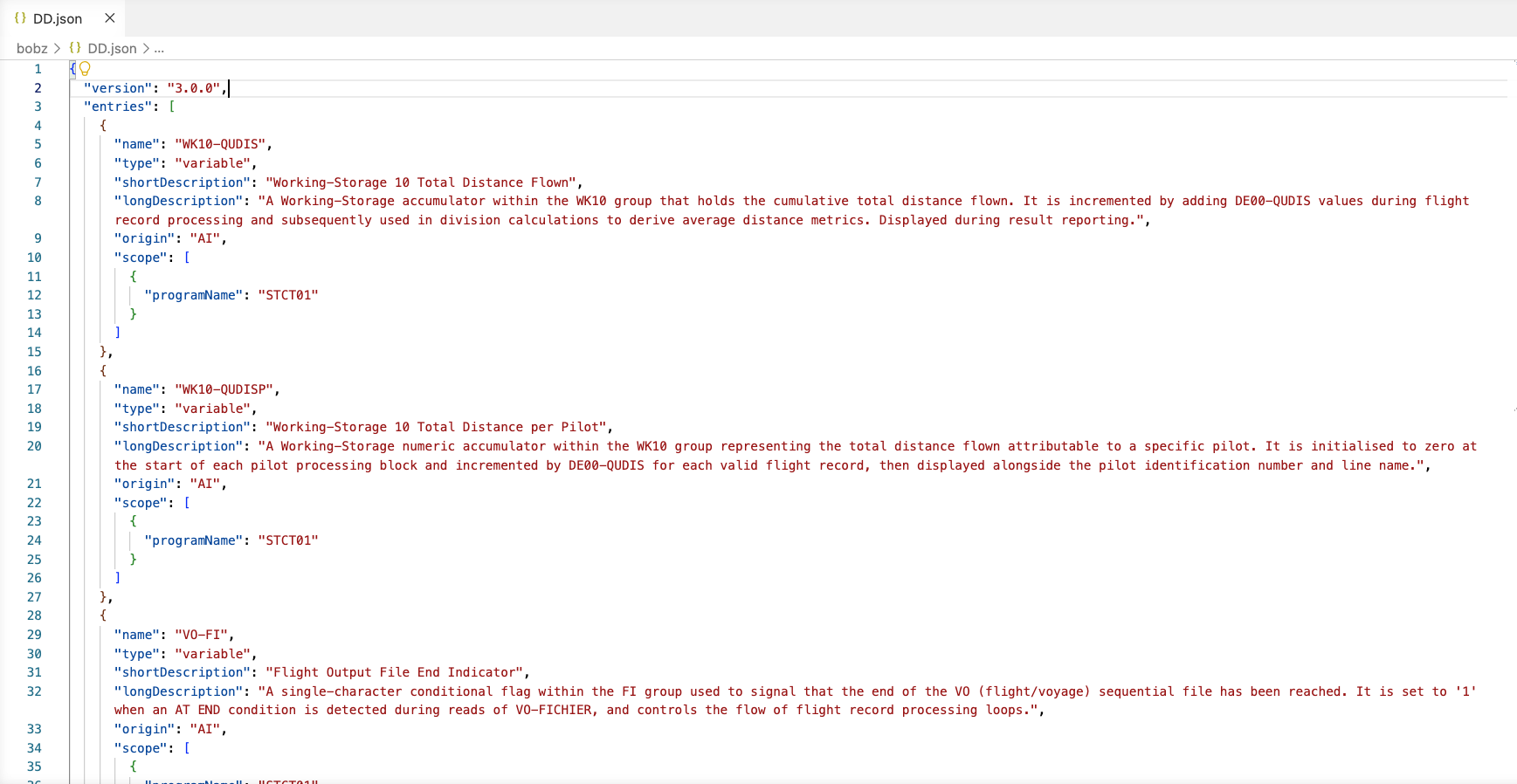
PP4Z generates these entries through static analysis of how each variable participates in the program. The analysis covers control flow, I/O operations, calculations, and data movement. Rather than attempting to document every field, it identifies the variables that most influence program behavior: the ones that, once named, make the rest of the program legible. Data dictionary entries can be managed locally or through the Z Understand container, with support for bulk generation, review, and synchronization across teams.
Documentation, explanation, and refactoring
The metadata, data dictionary, and model augmentation sections cover how PP4Z builds its picture of an application. This section covers what developers do with that picture.
Documentation and business rule extraction produce durable application knowledge at scale. Teams can generate structured documentation for COBOL, PL/I, and Assembler programs, covering program logic, data flows, and embedded business rules. They can use local scanner metadata for a focused scope or the Z Understand container for the full application. Business rules surface as part of that process, giving technical teams and modernization stakeholders a readable record of what the application does without manually tracing every paragraph.
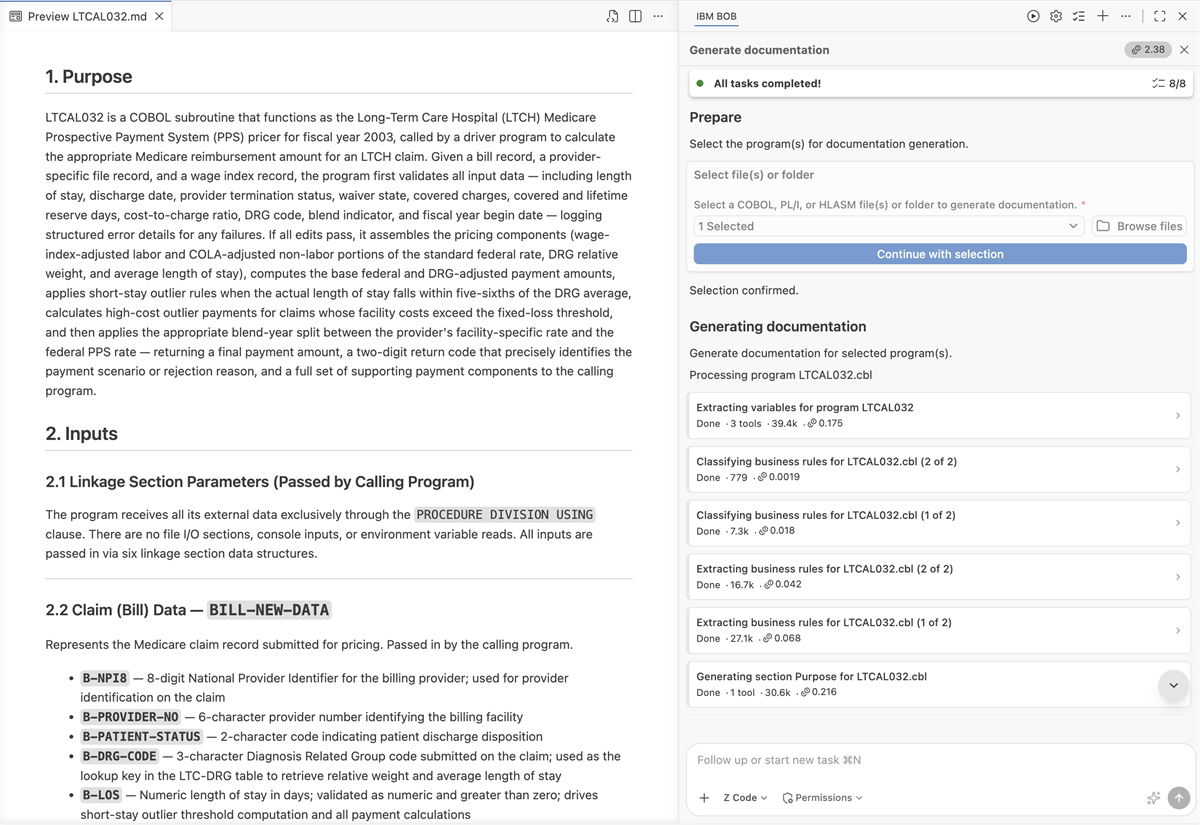
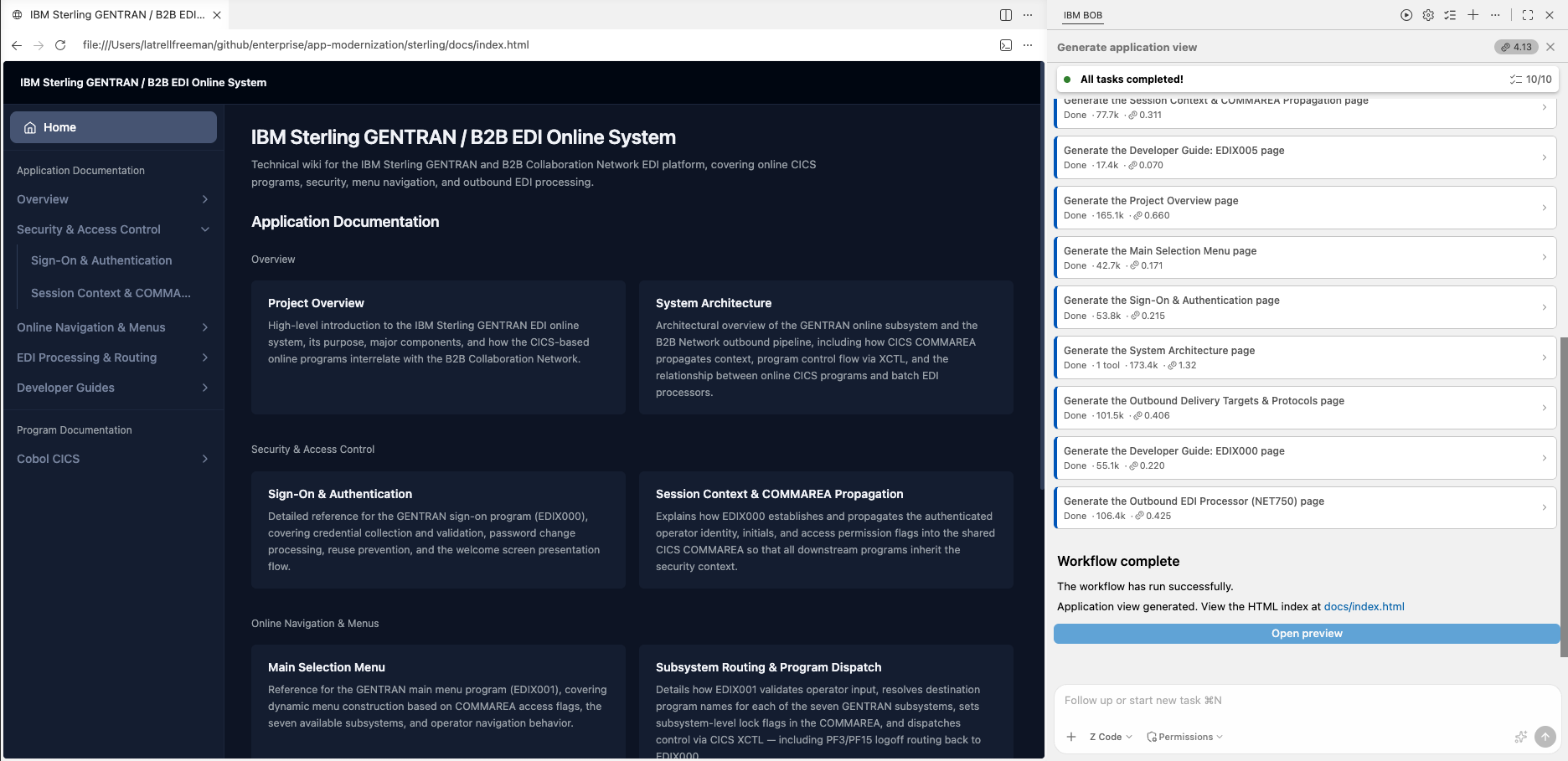
That program-level documentation can now be compiled into an application view, a structured site with diagrams and cross-referenced pages spanning the full application. Individual program documentation answers questions about one program. The application view gives teams and modernization stakeholders a map of the entire application.
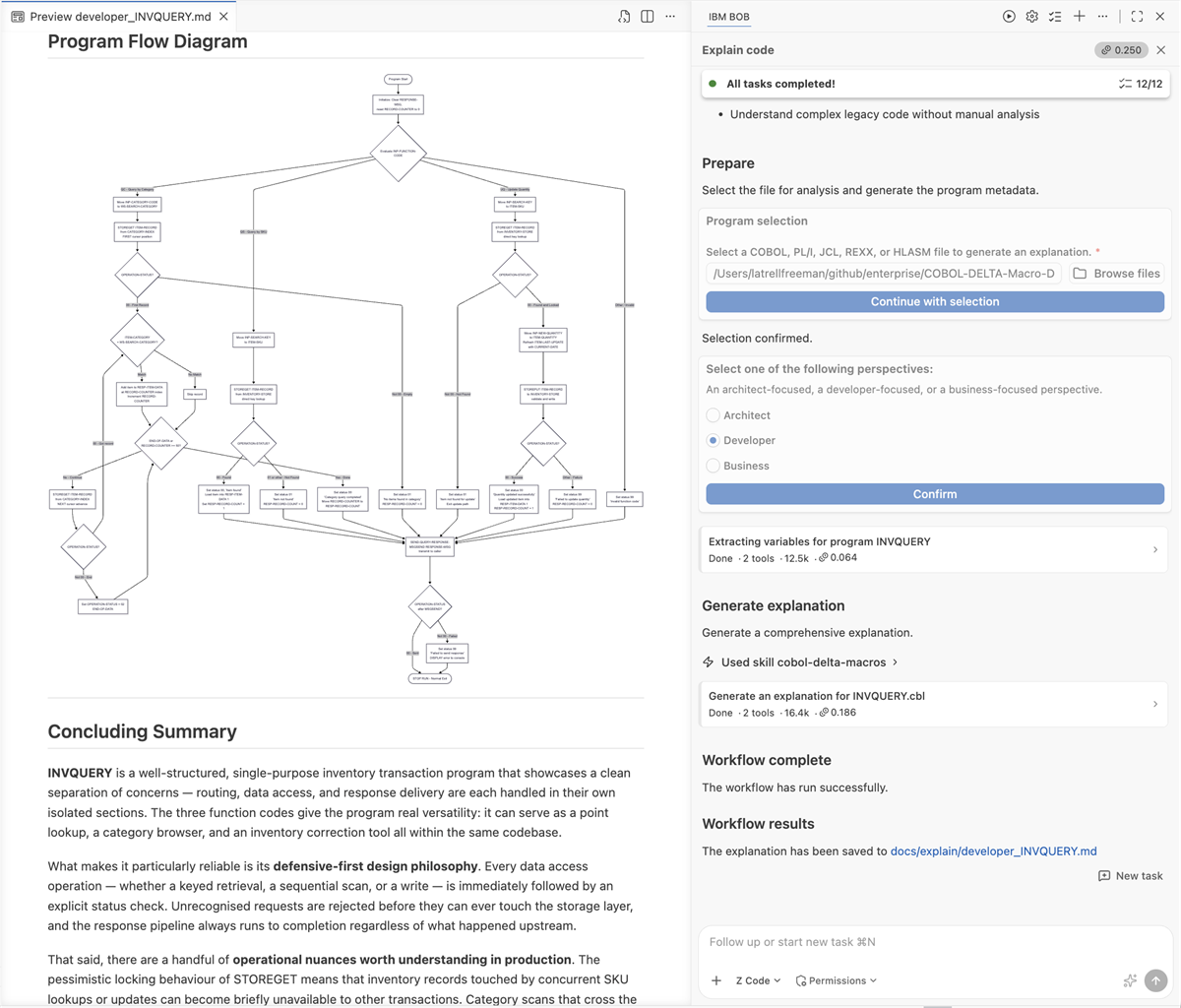
Comprehensive explanation generates a detailed explanation of a program from the perspective that matters most for the task at hand: Architect, Developer, or Business. PP4Z draws on application metadata, data dictionary entries, and its model augmentation layer to ground the explanation in the program's behavior.
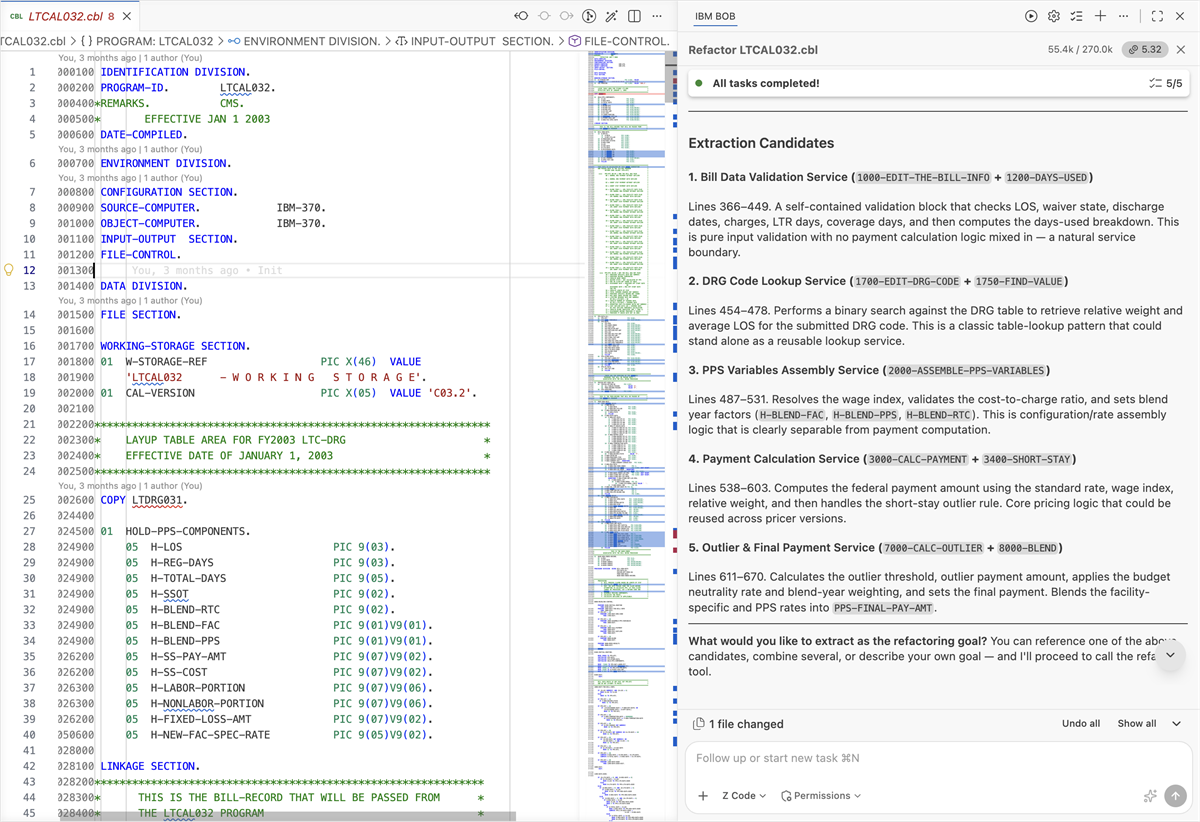
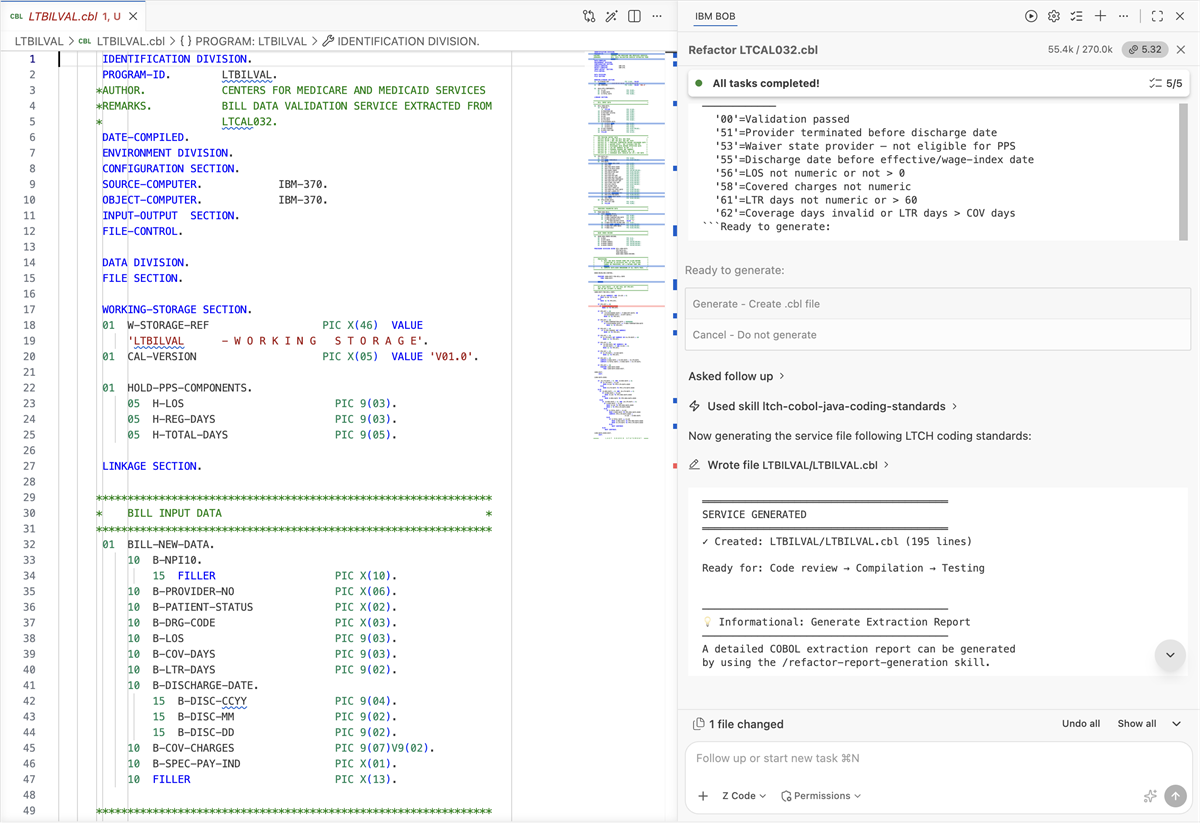
Refactoring uses the gathered context to restructure existing code into modular, reusable services while preserving functionality. The Refactor COBOL or PL/I program workflow identifies extraction candidates, maps their dependencies, and guides the transformation. This gives teams a practical modernization path that improves maintainability without requiring a full rewrite.
Integrated development, quality, and debug capabilities
Some parts of a developer's workflow have deterministic answers: whether code conforms to a rule, which path a given variable takes through a program, or where control transfers after a PERFORM. PP4Z handles these through dedicated tools. The model interprets the resulting facts in the context of what the developer is trying to accomplish.
In the PP4Z custom mode Z Code, Z Code Scan provides fast, rule-based static analysis for COBOL and PL/I programs. Its linter-style feedback catches issues without probabilistic inference. The custom mode Z Architecture provides control-flow and data-flow analysis, including how execution moves through a program and how data transforms as it flows between paragraphs and copybooks. These tools produce consistent, repeatable results regardless of how the question is phrased.
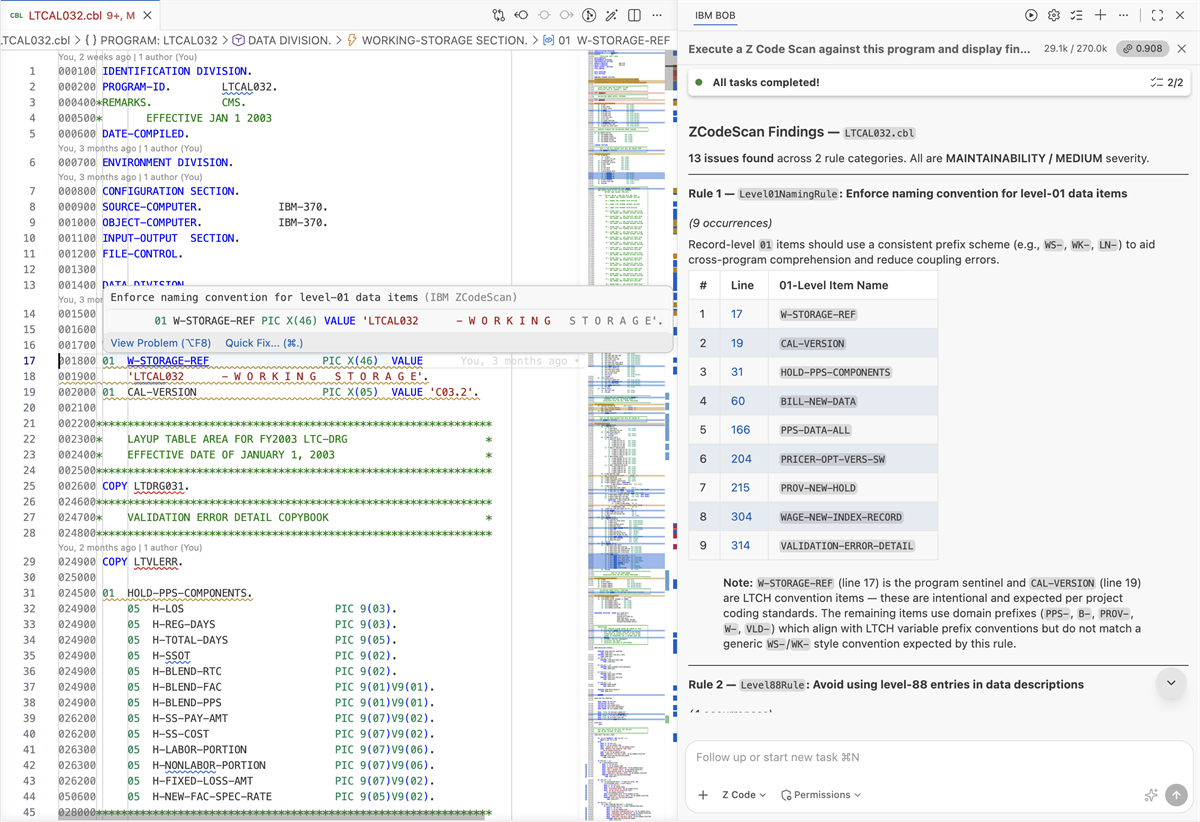
The model works with the output of those tools. It can interpret a scan result in the context of a proposed change or trace a data flow to answer a specific question about program behavior. Deterministic analysis handles what is rule-bound; AI handles what requires judgment.
PP4Z also includes IBM Debug for z/OS and code coverage capabilities, so teams can move from AI-assisted development directly into execution-level validation within the same environment.
Skill Builder for enterprise-specific knowledge
Application metadata, data dictionaries, model augmentation, and deterministic analysis form the IBM Z foundation that PP4Z ships. Skill Builder is how organizations layer their own knowledge on top of it.
With Skill Builder, teams can create custom skills that capture and apply enterprise-specific knowledge such as coding standards, naming conventions, technical patterns, business terminology, and environment-specific guidance. These skills help Bob understand how development is performed within a specific organization, reducing generic assumptions and improving the relevance of AI-generated responses. Skills can be automatically ingested and dynamically invoked when relevant to the user's request and code context, integrating directly into existing PP4Z workflows.

Bringing it all together
Scale, semantic density, and proprietary context make mainframe development difficult for general-purpose AI tools. PP4Z addresses each factor directly: structured metadata for scale, data dictionaries for business meaning, model augmentation for IBM Z documentation coverage, and deterministic tools for rule-bound analysis.
In this approach, AI reasoning and deterministic knowledge reinforce each other. Bob starts with structured metadata, draws on curated documentation, and interprets the output of rule-based tools. Developers can inspect that evidence before acting on the answer in a mission-critical environment.
To get started, pick one program your team has been avoiding, perhaps because its purpose is unclear or its business logic has not been touched in years. Run the local scanner to build its metadata and generate a data dictionary for its key variables. Use the explain workflow to understand what the program does, then run the documentation workflow to capture that knowledge in your workspace. From there, the same foundation supports impact analysis, refactoring, and quality validation. The team starts with a program it now understands.